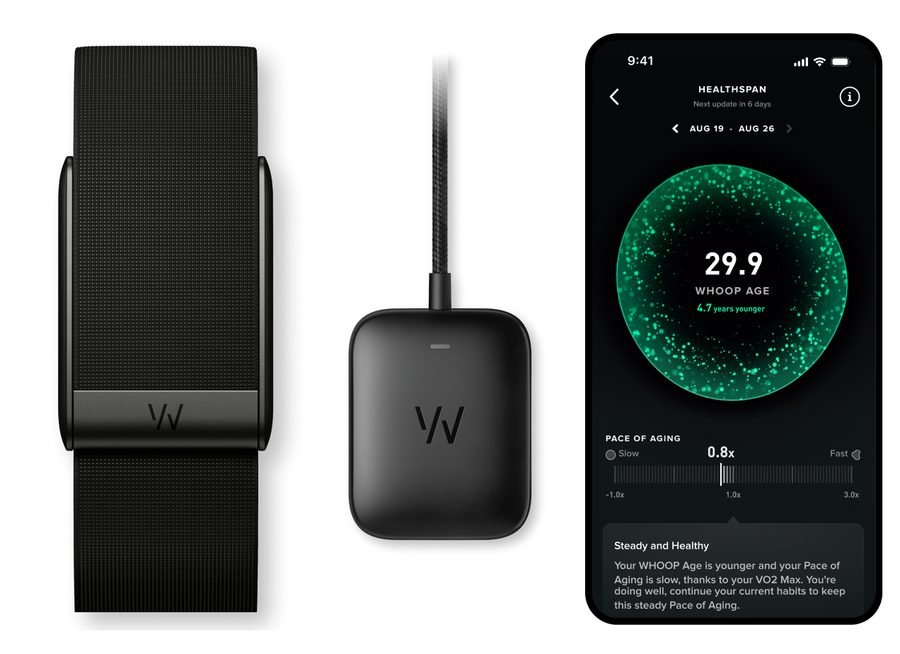
WHOOP Fitness Tracker
No screen, all data. Tracks HRV, strain, sleep, and recovery. The wearable for people who are serious about optimization.
Check price on AmazonAs an Amazon Associate I earn from qualifying purchases.
No screen, all data. Tracks HRV, strain, sleep, and recovery. The wearable for people who are serious about optimization.
Check price on Amazon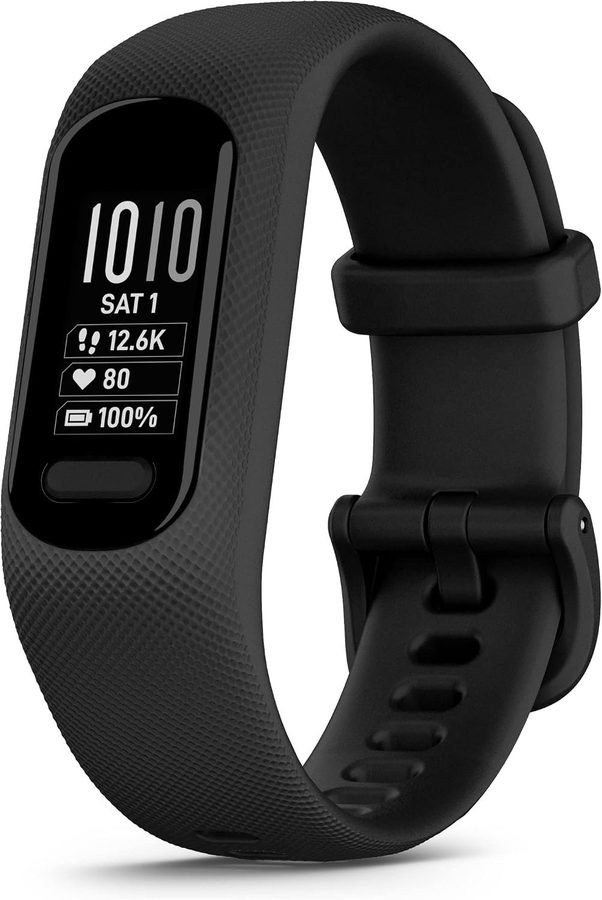
Long battery life and Garmin's running/cycling metrics without a bulky watch body.
Check price on AmazonA screenless recovery tracker against a slim data-rich sport band — for very different training questions.
Quick answer: obsessed with recovery, strain, and knowing when to back off? WHOOP. Training toward a specific pace or event and want real running/cycling metrics? Garmin Vivosmart 5.
| Spec | WHOOP | Garmin Vivosmart 5 |
|---|---|---|
| Price | $239 + subscription | $150, one-time |
| Screen | None — app only | Yes, slim OLED |
| Core focus | Recovery, strain, sleep | Training status, running/cycling metrics |
| Battery life | ~4-5 days | ~7 days |
| Subscription required | Yes, ongoing | No |
| Body Battery / recovery score | Yes (proprietary) | Yes (Garmin's Body Battery) |
| GPS | No (relies on phone) | No (relies on phone) |
Prices as of July 2026 — WHOOP's subscription cost varies by plan length, confirm current pricing.
Winner: Garmin Vivosmart 5, for most buyers, on total cost of ownership alone — no subscription means the $150 you pay once is the only money you'll ever spend, versus WHOOP's hardware cost plus an ongoing subscription that adds up to real money over 2-3 years. Buy WHOOP instead if recovery and strain scoring is specifically the problem you're trying to solve — if you train hard enough, often enough, that knowing whether today is a push day or a backoff day has real value, WHOOP's entire product is built around answering exactly that question in a way Garmin's more generalist approach doesn't match.
It's tempting to compare these on spec sheets, but they're genuinely built for different questions. WHOOP asks "how recovered am I, and should I push or back off today?" — everything about the device, from the screenless design to the daily recovery percentage, is built around answering that one question as precisely as possible. The Vivosmart 5 asks a broader set of questions: "how many steps did I take, how did my run go, is my training status productive or am I overreaching?" It has a Body Battery energy metric that's philosophically similar to WHOOP's recovery score, but it's one feature among many rather than the entire point of the device. Buying WHOOP for its running pace data would be a mismatch — it doesn't really try to compete there. Buying the Vivosmart 5 for deep recovery insight is reasonable, but WHOOP is more singularly focused and, for that specific use case, deeper.
This is the actual financial decision hiding behind both devices' price tags. WHOOP's hardware cost is only part of the total cost — the subscription is mandatory to use the device at all, not an optional upgrade layer. Over two to three years, WHOOP's total cost of ownership meaningfully exceeds the Vivosmart 5's one-time $150, even before accounting for the Garmin's zero ongoing cost. That doesn't make WHOOP a bad purchase — if the recovery and strain data genuinely changes how you train and prevents overtraining or injury, the subscription can pay for itself in a way that's hard to put a precise number on. But it does mean the honest price comparison isn't $239 versus $150 — it's $239 plus years of subscription fees versus a flat $150, and that gap is worth sitting with before buying WHOOP specifically for the data rather than the screenless novelty.
WHOOP's screenless design is a deliberate choice, not a cost-cutting measure — the idea is that checking a screen constantly (time, notifications, stats) pulls you out of a workout and into "device-checking" mode, and removing the screen removes that temptation entirely. Some users find this genuinely improves their relationship with the device, letting the data collect passively without becoming another thing to check compulsively. Others find a screenless band frustrating for basic things like checking the time or seeing a text notification without pulling out a phone. The Vivosmart 5's slim screen is a middle ground — smaller and less distracting than a full smartwatch display, but present enough for at-a-glance stats and notifications. Which approach you'll actually prefer daily is a genuinely personal call, and it's worth thinking honestly about whether you're someone who'd use a screenless design as intended, or someone who'd just feel unmoored without a display.
Both devices attempt to answer a similar underlying question — how taxed is your body right now, and how much can it handle today — but the depth and presentation differ. WHOOP's strain score accounts for all-day activity (not just structured workouts) against your personal HRV and sleep data, producing a daily recovery percentage that's the product's central feature, refined over years of being the whole point of the device. Garmin's Body Battery does something conceptually similar — an energy-level score from 0-100 based on HRV, sleep, and activity — but it's one metric among a much broader feature set (pace, cadence, training status, VO2 max estimates) rather than the device's singular focus. Neither is objectively "more accurate" in a way that's easy to independently verify, but WHOOP's is more refined specifically because it's the only thing WHOOP does, while Garmin's is genuinely useful but shares attention with everything else the device tracks.
WHOOP: the strap and battery pack system is the part most specific to WHOOP's design — the battery pack slides onto the strap for charging without removing the device, which is convenient but adds a second piece of hardware to maintain. Straps are a wear item by design and sold as replacements; expect to swap yours after a year or two of daily wear, especially if you sweat heavily during training. The core sensor pod has a solid reliability reputation within a normal ownership window.
Garmin Vivosmart 5: the band is the first thing to show wear, particularly the material around the buckle or clasp — Garmin sells replacement bands for exactly this reason. Battery capacity, like any rechargeable device, degrades gradually over 2-3 years of daily charge cycles, and expect the quoted week-long battery life to shrink somewhat by that point. The screen and core sensor package have a strong reliability track record within Garmin's typical device lifespan.
Skip WHOOP if you're not training with any real intensity or consistency — someone walking a few times a week and lifting casually won't generate enough strain variance for the recovery score to say anything useful day to day, and paying an ongoing subscription for a number that barely moves is money wasted. It's also the wrong pick if you want a device that shows you anything at all without opening a phone — no screen means no glance-and-go, ever, which is a genuine daily annoyance for people who just want to check the time or a step count without pulling out their phone.
Skip the Vivosmart 5 if recovery and overtraining risk is your actual, specific concern — its Body Battery is a reasonable general-purpose energy metric, but it's not built with WHOOP's single-minded depth, and someone who genuinely needs to know whether today is a push day or a backoff day will find Garmin's broader, shallower approach less useful for that one question. It's also a mismatch for anyone who wants to feel a device disappear entirely — the screen and notifications, while minimal, are still a small daily presence WHOOP's screenless design deliberately avoids.
Neither device replaces the training program itself — both are measurement tools that tell you about load and recovery, not tools that decide your workouts for you. Pairing either with an actual structured training plan is what turns the data into a real training advantage rather than an interesting number you check and ignore. See our fitness tracker buyers guide for how these two fit against Fitbit, Polar, and Amazfit if you're still deciding on category rather than just these two brands.
Mandatory for meaningful use — WHOOP's entire feature set, including basic recovery and strain data, lives behind the subscription. The hardware alone, without an active subscription, doesn't function as a useful tracker.
No — Garmin Connect, the companion app, is free, and all core Vivosmart 5 features work without any subscription. This is one of its clearest advantages over WHOOP for anyone prioritizing total cost of ownership.
Neither is a chest strap, so both share the general limitation of wrist-based optical sensors compared to something like a Polar H10. Between the two, reported accuracy is broadly comparable for everyday tracking purposes; neither has a strong, well-documented edge over the other specifically.
Yes — WHOOP doesn't have built-in GPS, so runners typically pair it with a phone's GPS tracking or a separate running app for pace and route data, using WHOOP specifically for the recovery and strain layer on top.
It's a reasonable proxy and many users find it genuinely useful, but it's less singularly refined than WHOOP's score, since Garmin splits attention across many features rather than concentrating entirely on recovery. If recovery scoring specifically is your main priority, WHOOP's version is the more purpose-built tool.
Both track sleep stages and duration reasonably well for consumer wearables. WHOOP's screenless, all-night comfort design and its central focus on sleep-as-recovery-input give it a slight edge in depth of sleep-specific insight, while the Vivosmart 5's sleep tracking is solid but one feature among many rather than a specialty.