 Top Pick
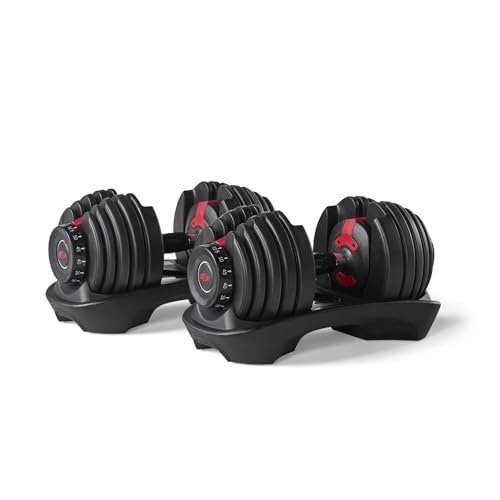
Bowflex SelectTech 552 Dumbbells
5 to 52.5 lbs in one dumbbell. Replaces 15 sets of weights. The home gym essential if you only buy one thing.
Check price on AmazonAs an Amazon Associate I earn from qualifying purchases.
The two best adjustable dumbbells compared on weight range, durability, and value.
Quick answer: want dumbbells that feel like real dumbbells and this is your only set? Bowflex 552. Tight on space or planning to go heavier than 50 lb someday? PowerBlock.
| Spec | Bowflex SelectTech 552 | PowerBlock Elite EXP |
|---|---|---|
| Weight range | 5-52.5 lb/hand (2.5 lb jumps to 25 lb) | 5-50 lb/hand; expandable to 70/90 lb with add-on kits |
| Adjustment | Turn dial, lift off cradle | Pin-select, pull handle at target weight |
| Shape | Round/oval -- moves like a normal dumbbell | Square brick -- stacks flat, will not roll |
| Footprint (each) | 16.9 x 8.3 in. | 12 x 6.25 in. |
| Price | ~$429-479/pair | ~$389-469/pair (Stage 1) |
| Expandable later | No -- 52.5 lb is the ceiling | Yes -- Stage 2/3 kits add weight to the same base |
Prices as of July 2026 -- both brands run frequent sales, confirm at checkout.
Winner: Bowflex SelectTech 552, for most buyers. It's the pick if this is going to be your only dumbbell set for years, because the round, weighted-head shape genuinely feels like a normal dumbbell in your hand — that matters more than it sounds for exercises like rows, curls, and single-arm presses where grip angle and balance affect how the weight loads your joints. Buy the PowerBlock Elite EXP instead if floor space is a real constraint, if you specifically know you'll want to go past 50 lb per hand within the next couple of years, or if you've ever had a round dumbbell roll off a bench or across the floor and want a shape that physically can't do that.
This is the single biggest practical difference between these two, and it's worth explaining rather than just noting. The Bowflex 552 keeps its weight plates arranged in a roughly cylindrical shape around a center handle — pick it up and it feels, moves, and balances like a traditional cast-iron dumbbell, because the weight distribution is similar. The PowerBlock stacks square weight "shells" around a selector pin, which means the effective shape is a rectangular brick, not a cylinder. For pressing movements — bench press, overhead press — the difference is minor once the weight is locked in your hand. For movements where the dumbbell needs to rotate or where your wrist changes angle mid-rep — rows, curls with any twist, renegade rows, single-arm swings — the Bowflex's rounder profile is more forgiving on the wrist and more intuitive if you've trained with standard dumbbells before. People switching from a commercial gym's dumbbell rack to a home adjustable set notice this immediately; it's the most common complaint about brick-style adjustables in reviews, and PowerBlock has narrowed the gap over generations of the product without fully closing it.
Both of these get used constantly in a home gym, and both hold up well — but not identically, and not without maintenance.
Bowflex SelectTech 552: the selector dial mechanism is the part under the most repeated stress — every single set means turning the dial, lifting the handle off the cradle, and setting it back down. The plastic weight plates that make up the shell are durable but not indestructible; dropping a Bowflex dumbbell from height (rather than lowering it to the cradle) is the single most common way people crack a shell, and a cracked shell means an audible rattle and, eventually, replacement. The dial mechanism itself very rarely fails outright within a normal ownership period, but it can develop a slight stiffness or a "catch" at certain weight settings after a couple of years of heavy daily use — usually resolved by making sure the cradle is on a completely level, hard surface, since an uneven cradle is the most common cause of dial issues people report.
PowerBlock Elite EXP: the selector pin is the equivalent stress point, and it's a simpler mechanism — a metal pin through a stack of shells rather than a rotating dial — which some owners find more durable over the long run precisely because there's less that can go wrong mechanically. The tradeoff is the pin-pull motion itself: pulling the pin at the correct weight and re-seating it takes a bit more attention than Bowflex's turn-the-dial motion, and a pin that isn't fully seated before a lift is a real safety issue (a partial weight can shift under load) in a way a Bowflex dial mostly isn't. The rubberized end caps on the shells are the wear item — they can compress or peel at the edges after a couple years of the dumbbells being set down on a hard floor rather than a mat.
This is where PowerBlock's design philosophy pays off in a way that's easy to underweight when you're comparing sticker prices. The Bowflex 552 tops out at 52.5 lb per hand — full stop, there's no factory expansion kit. If you outgrow that ceiling (which happens faster than beginners expect on lower-body movements like goblet squats and lunges, even if upper-body work stays within range longer), your only options are buying a second, heavier adjustable set or switching to a different system entirely. The PowerBlock Elite EXP starts at a 50 lb/hand ceiling in its base Stage 1 kit, but PowerBlock sells Stage 2 and Stage 3 expansion kits that bolt onto the same base and selector, taking the same physical dumbbells up to 70 lb or even 90 lb per hand without replacing anything you already own. If there's a realistic chance you'll want to keep progressing past 50 lb — which is common for anyone doing serious lower-body or back work — that expandability is worth factoring into the price comparison now, not after you've already hit the Bowflex's hard ceiling.
Both are excellent adjustable dumbbell systems, but neither replaces a full barbell setup for anyone chasing serious strength numbers past what dumbbells can safely provide — even PowerBlock's 90 lb expanded ceiling is well below what a loaded barbell allows on a squat or deadlift. Think of either of these as the core of a home gym's first year or two, not a permanent substitute for a rack and barbell once your numbers climb. See our best home gym equipment roundup for how a rack and barbell fit in alongside either of these, and our adjustable dumbbells guide for the full ranked field beyond just these two.
Both brands publish weight increments accurate to within a small fraction of a pound at each setting — in practice neither is meaningfully "more accurate" than the other for real training purposes. The bigger practical difference is increment size: Bowflex adjusts in 2.5 lb jumps up to 25 lb per hand, then larger jumps after that, while PowerBlock's increments vary by model but are generally comparable.
No — neither is designed for dropping from height the way a rubber-coated fixed dumbbell is. Both should be lowered to the floor or cradle under control; dropping either risks cracking the Bowflex's plastic shells or damaging PowerBlock's selector mechanism and shell edges.
Slightly, in that pulling and reseating a pin takes marginally more attention than turning a dial, and a not-fully-seated pin is a real safety consideration. Most owners adjust to it within the first few sessions; it's not a significant learning curve, just a different motion.
Both hold value reasonably well as established, well-known brands in the adjustable dumbbell category. Bowflex's broader brand recognition can make it slightly easier to resell quickly; PowerBlock's simpler mechanical design (a pin versus a dial) is sometimes cited by buyers as a reason to trust a used unit's condition more easily at a glance.
Not strictly, but a stand keeps the cradle (Bowflex) or base (PowerBlock) elevated off the floor, which most owners find more comfortable for picking up and setting down repeatedly during a workout, and keeps them out of the way when not training. It's a reasonable add-on purchase, not a requirement for either system to function.
Yes — the dumbbell handle length and grip design on both are built to standard dumbbell proportions and aren't height-dependent the way a barbell or rack might be. Taller lifters occasionally note that either set's overall shape takes a little adjustment when performing floor presses at full extension, but this applies equally to both, not one over the other.
Top Pick
5 to 52.5 lbs in one dumbbell. Replaces 15 sets of weights. The home gym essential if you only buy one thing.
Check price on Amazon