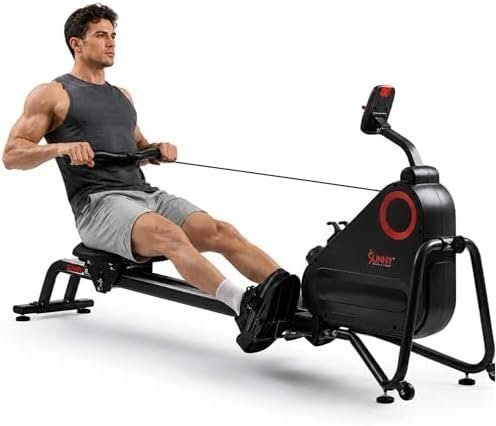
Sunny Health & Fitness Magnetic Rowing Machine
Smooth magnetic resistance, folds for storage. Full-body cardio that's easier on the joints than running.
Check price on AmazonAs an Amazon Associate I earn from qualifying purchases.
Smooth magnetic resistance, folds for storage. Full-body cardio that's easier on the joints than running.
Check price on Amazon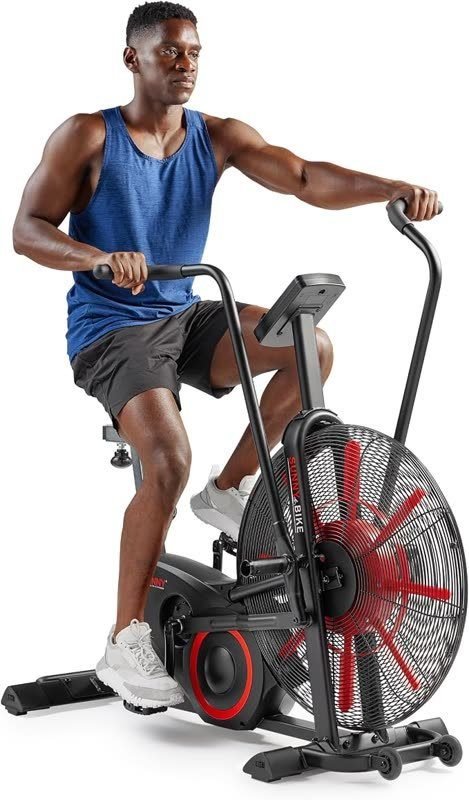 Top Pick
Fan bike that humbles everyone. Full body cardio, sturdy steel build, at a fraction of the boutique-brand price.
Check price on AmazonFull-body magnetic rowing versus punishing air-resistance cycling — compared on noise, joint impact, and who each one actually suits.
Quick answer: want a quieter, full-body machine that folds away and is easier on the joints? Sunny Magnetic Rowing Machine. Want the single hardest cardio session available at home and don't share thin walls? Sunny Smart Fan Bike.
| Spec | Sunny Magnetic Rowing Machine | Sunny Smart Fan Bike |
|---|---|---|
| Price | $250 | $399 |
| Resistance type | Magnetic, 8 levels | Air, unlimited (scales with effort) |
| Noise | Quiet | Loud — audible through walls |
| Footprint | Folds upright for storage | Fixed, stays assembled |
| Weight capacity | 265 lb | ~300 lb |
| Joint impact | Low — smooth, seated pulling motion | Low-impact but higher perceived intensity |
| Muscle engagement | Full body — legs, back, arms | Full body — dual action arms plus legs |
Prices as of 2026 — both fluctuate with promotions, confirm at checkout.
Both are pitched as "the one machine that trains your whole body," and both are telling the truth — they're just built around different intensity profiles and different daily-use tradeoffs. The rowing machine is the pick for people who want consistent, repeatable full-body cardio they'll actually do most days without dreading it. The fan bike is the pick for people who specifically want intervals hard enough to hurt, and who have the space and soundproofing to make that noise without it becoming a household problem.
Rowing recruits legs, back, and arms in a single stroke, which is a genuinely efficient way to get full-body conditioning in a short session — and because the resistance is magnetic rather than air, the motion stays smooth and controllable at every level instead of scaling unpredictably with effort. It folds upright when you're done, which matters more than it sounds for anyone without a dedicated workout room. It's also meaningfully quieter than the fan bike, which makes it the realistic choice for early mornings, apartments, or training while someone else in the house is asleep or on a call.
Air resistance has no ceiling — the harder you push, the harder it pushes back, so the same machine handles an easy warm-up spin and an all-out sprint interval without touching a dial. Dual action arms mean your upper body works simultaneously with your legs, which is why fan bike intervals get compared directly to rowing for total-body demand, but with a distinctly different, more anaerobic feel. For anyone specifically chasing the hardest, most efficient interval session available at home, the fan bike's uncapped resistance curve is the honest reason to pick it over the rower.
This is the single most common reason people regret a fan bike purchase after the fact, so it's worth being blunt about it. The fan bike's whoosh is genuinely loud — audible through a wall, noticeable on a video call in the next room, and a real problem for early-morning or late-night sessions in an apartment or a house with shared walls. The rowing machine's magnetic resistance is close to silent by comparison; you'll hear the seat rollers and your own breathing more than the machine itself. If noise is a real household constraint — thin walls, a partner who works nights, young kids sleeping nearby — that alone can and should decide this comparison regardless of which machine otherwise sounds more appealing on paper.
Both are legitimately hard machines, but they get there differently. Rowing at a steady, sustainable pace is a genuinely effective aerobic session that most people can hold for 20-30 minutes; pushing rowing into sprint intervals is also possible and brutal in its own right, but the machine doesn't force that intensity on you — you choose your pace within the 8 magnetic levels. The fan bike's air resistance means intensity scales automatically with effort: a lazy pedal stroke feels easy, and pushing harder immediately feels proportionally harder with no artificial ceiling, which is exactly why fan bike intervals (20 seconds all-out, 40 seconds easy, repeated) have a reputation for being uniquely punishing in the fitness world. If your goal is a sustainable daily cardio habit, the rower's more forgiving intensity curve is easier to keep showing up for. If your goal is the single hardest, most efficient interval session you can fit into 15 minutes, the fan bike delivers that in a way few home machines can match.
The rowing machine folds upright, which turns "cardio machine" from a permanent piece of furniture into something that lives against a wall between sessions — a real advantage in any space that isn't a dedicated home gym room. The fan bike doesn't fold; its frame stays assembled and takes up a fixed footprint whether you're using it or not. For a small apartment or a shared living space, that difference in how the machine behaves when you're not actively training it is often more relevant day to day than any spec on the resistance curve.
Sunny Magnetic Rowing Machine: the seat rollers are the wear item on any rower — they'll start to squeak before anything actually fails, and a drop of household oil on the rail resolves most squeaks. The rail and frame are steel and hold up well under normal home use; the folding hinge is worth an occasional check to make sure it's still locking securely when unfolded for a session.
Sunny Smart Fan Bike: the fan blades and belt-driven resistance mechanism see the most repeated stress, especially under hard interval use — a squeak or slight looseness in the belt after a year or two of heavy use is common and usually a simple tension adjustment, not a structural problem. The dual action arm pivots are the other point worth checking periodically, since they take real force during upper-body-driven intervals.
Both arrive partially disassembled, and neither requires more than basic tools — expect 30-45 minutes for the rowing machine, mostly attaching the rail to the seat mechanism and monitor, and roughly the same for the fan bike, which involves attaching the base, seat post, and handlebar assembly to the main frame. Neither is a same-day-unbox-and-go product, so budget the time before your first planned session rather than assembling it under time pressure. Once built, both are stable enough that they don't need reassembly or re-tightening beyond an occasional bolt check every few months of regular use.
Skip the rower if your specific goal is the hardest possible short interval session and you have the space and soundproofing to support it without disturbing anyone — the rower's smoother resistance curve simply won't push you as hard, as fast, as a fan bike will for someone chasing that specific training effect.
Skip the fan bike if noise is a genuine household constraint, or if your realistic goal is a sustainable, most-days cardio habit rather than an occasional brutal interval session — the fan bike's intensity and noise both work against consistency for someone who just wants to move most days without it feeling like a fight every time.
Winner: Sunny Magnetic Rowing Machine, for most buyers. It's quieter, folds away, and its resistance curve is more forgiving day to day, which matters more for building a lasting cardio habit than raw maximum intensity does. Buy the Sunny Smart Fan Bike instead if you specifically want the hardest interval training available at home, you have the space for a fixed-footprint machine, and noise genuinely isn't a constraint in your living situation.
It depends more on effort and duration than the machine itself, but the fan bike's uncapped intensity curve means a maximal-effort session on it can burn calories faster per minute than a moderate rowing session — the rowing machine wins over a longer, sustained session at a pace most people can actually hold.
Both are low-impact compared to running, since neither involves ground-strike force. The rowing machine's seated, sliding motion is generally considered gentler on the knees specifically; the fan bike's standard pedaling motion is also joint-friendly but the standing/dual-arm variations add more load through the shoulders and core.
Beginners can use it, but the honest advice is to start at low effort and resist the urge to match the intensity fan bike intervals are known for online — the machine scales resistance to your own effort, so a beginner going easy gets an easy, appropriate session, not a forced hard one.
All three — a proper rowing stroke is roughly 60% legs, 20% core, and 20% arms/back in terms of drive sequence, so while legs do more of the raw power output, arms and back are genuinely worked through the pull and finish of every stroke, not just along for the ride.
Neither has an inherent edge for fat loss — that comes down to total energy expenditure and consistency over time, not the specific machine. The more honest answer is: whichever one you'll actually use most days is the better weight-loss machine for you personally, and that's exactly why noise, footprint, and how each one feels matter more than any calorie-burn spec sheet.
For the full ranked cardio machine field including budget and small-space options, see best cardio machines and the small-space cardio guide if floor space is the deciding constraint.