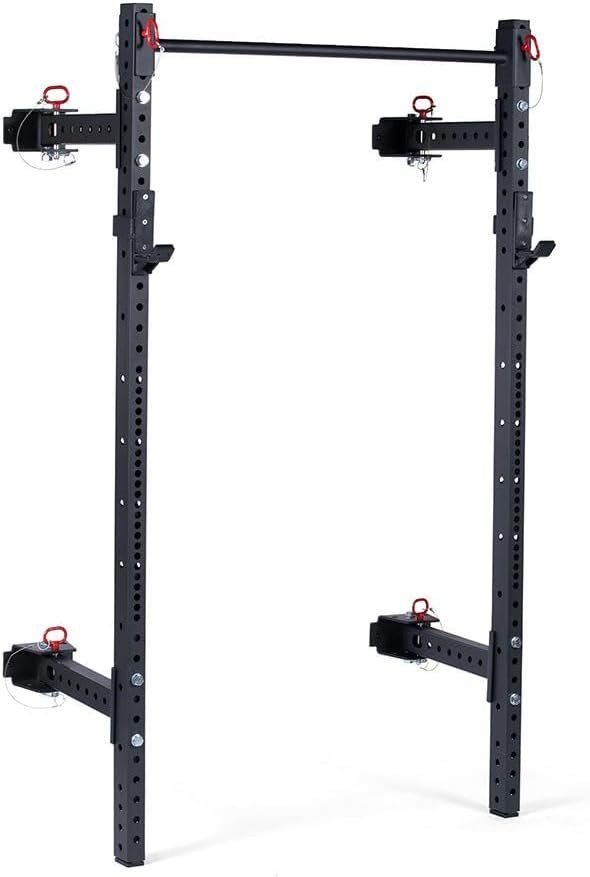
 Space Saver
Titan Fitness T-3 Wall-Mounted Folding Power Rack
Folds flat against the wall when not in use. Full squat-rack strength training without losing the garage.
Check price on AmazonAs an Amazon Associate I earn from qualifying purchases.
Both are excellent racks under $900. Here's the one that wins for your setup.
Quick answer: on a budget and you just want the numbers on the spec sheet? Go Titan T-3. Want a rack that outlives your gym and a company that still backs it in 15 years? Go Rogue R-3.
| Spec (24-in. depth) | Rogue R-3 | Titan T-3 |
|---|---|---|
| Price | $870 | $599.97 |
| Steel | 2 x 3 in. 11-gauge, USA-made | 2 x 3 in. 11-gauge |
| Height | 90.375 in. | 91 in. |
| Footprint | 53 x 34 in. | 54 x 32.75 in. |
| Hole pattern | Westside (1 in. through bench/pull zone, 2 in. elsewhere), 5/8 in. holes | Westside + 6 in. side spacing, 11/16 in. holes |
| Rack weight | 200 lb | 196 lb |
| Rackable capacity | Not published by Rogue | 1,100 lb / station, 4,400 lb whole rack |
| Pull-up bar | 43 in. fat/skinny (1.25 & 2 in.) | 1.25 in. standard + 2 in. fat bar |
| Warranty | Limited lifetime on frame & welds | 1 year included (extendable) |
Prices as of July 2026 -- both brands run frequent sales, confirm at checkout.
Winner: Titan T-3, for most home-gym lifters — steel-for-steel these two are functionally the same rack (identical 2x3 in. 11-gauge tubing, comparable hole spacing), and $270 buys real additional equipment: a bench, a barbell, or a meaningful chunk of a plate set. Buy the Rogue R-3 instead if you're planning to build out a full multi-year rig with cable attachments, a lat tower, or a dip station from the same ecosystem, or if a lifetime warranty and Rogue's resale reputation genuinely matter more to you than the $270 price gap.
Both racks use 2x3 inch, 11-gauge steel tubing — on paper, that's the number that matters most for a power rack's structural rigidity, and it's genuinely reassuring that Titan matches Rogue here rather than cutting corners on the core material. But steel gauge alone doesn't capture everything about how a rack performs under load over years of use. Welds, laser-cut hole tolerances, and powder-coat finish quality are harder to spec-sheet-compare and are where a lot of the actual price difference between premium and budget rack brands lives. Rogue's reputation is built specifically on weld consistency and finish quality at scale — a decade-plus of being the reference brand serious lifters compare everything else against. Titan's T-3 has closed the gap significantly compared to budget racks from years past, and steel-for-steel it's a legitimately comparable rack, but Rogue's manufacturing consistency still has a slight edge in most side-by-side owner reports, particularly on weld cleanliness at the joints.
This is a spec that looks like a minor footnote but affects daily use more than people expect. Rogue's Westside hole pattern uses 1-inch spacing through the bench and pull-up zone (where fine adjustment for J-cups and safety spotter arms matters most) and wider 2-inch spacing elsewhere. Titan's T-3 uses Westside spacing too, but with 6-inch side-to-side hole spacing and a slightly larger 11/16-inch hole diameter versus Rogue's 5/8-inch. In practice: Rogue's tighter 1-inch spacing through the working zone lets you fine-tune J-cup height more precisely for pressing movements, which matters more the more particular you are about bar path and unrack height. Titan's larger hole diameter can mean a very slightly looser fit for some attachments not specifically designed for the T-3, though Titan's own accessories are built to match.
Titan sells more than one product under a "T-3" name, and it's worth being precise about which one you're comparing here. This page compares the freestanding Titan T-3 power rack ($599.97, not currently sold through Amazon) against the Rogue R-3. Titan also sells a separate T-3 Series Wall-Mounted Folding Power Rack (around $300, shown below, and available on Amazon) — a genuinely different product built to fold flat against a wall when not in use, for garages and small spaces where a permanent freestanding footprint isn't an option. It's lighter-duty and built for a different use case than either freestanding rack in the comparison table above; it's the right pick if wall-folding is a hard requirement, not a cheaper way to get the freestanding T-3's specs. See our best home gym equipment roundup, which covers the wall-mounted folding option in more depth, if a fold-away rack is what you actually need.
Rogue R-3: these racks have a long track record in gyms that see heavy daily use, and structural failure within a normal ownership period is rare enough to be a non-issue for home use. What does show wear: the powder coat can chip at high-contact points (where a barbell repeatedly touches J-cups or where plates bump the uprights during loading) after years of heavy use — cosmetic, not structural, and touch-up paint handles it. J-cups and pull-up bar knurling are the components that see the most direct wear and are also the easiest and cheapest to replace individually without touching the frame.
Titan T-3: similarly solid for structural longevity under normal home-gym use — the published capacity numbers (1,100 lb per station, 4,400 lb total) are aggressive and give real margin above what most home lifters will ever load. The same powder-coat chipping pattern at high-contact points applies here too. Titan's included one-year warranty (extendable at additional cost) versus Rogue's limited lifetime warranty is the more meaningful long-term difference — not because Titan racks are expected to fail, but because if something does go wrong five or ten years in, Rogue's policy covers it and Titan's standard policy, without an extension purchased up front, doesn't.
This is where the Rogue premium earns its keep for a specific kind of buyer. Rogue's Infinity/Monster Lite hole-spacing ecosystem (which the R-3 uses) is compatible with a genuinely enormous third-party and first-party accessory catalog — lat pulldown attachments, cable crossover stations, dip bars, landmine attachments, and more, all built to bolt directly onto the same rack without adapters. If your home gym plan is "buy a rack now, add a cable station and lat tower in two years," buying into the Rogue ecosystem from day one avoids compatibility headaches later. Titan has its own accessory line built to fit the T-3 specifically, and it's grown substantially, but it doesn't match Rogue's third-party accessory depth — if you want the widest possible future accessory selection, that's a real point in Rogue's favor, not just brand loyalty.
At 90.375 in. (Rogue) versus 91 in. (Titan), both racks need roughly a standard 8-foot ceiling with a few inches of clearance for the pull-up bar and safe overhead lockout on presses — measure your actual ceiling height, including any light fixtures or ductwork in the footprint, before ordering either. Footprint is nearly identical too (53x34 in. for Rogue, 54x32.75 in. for Titan), so the floor-space decision genuinely comes down to which orientation fits your garage or basement layout better, not which brand is more compact — neither has a meaningful footprint advantage over the other.
A power rack is the frame everything else in a serious strength setup hangs off of — but it's not the whole gym. Neither of these racks includes a barbell, plates, or a bench; budget for those separately regardless of which rack you choose. See our best home gym equipment roundup for how a rack, barbell, and bench fit together as a complete system, and our home gym budget tiers guide for when a rack purchase makes sense relative to everything else on the list.
No — this is actually one of the closer steel-spec matchups in the rack category. A lot of budget racks use thinner or lower-quality steel than premium brands to hit a lower price point; Titan specifically choosing to match Rogue's 2x3 in. 11-gauge tubing is why the T-3 gets recommended over cheaper racks that cut the steel spec to save cost.
For most lifters, Titan's spacing is fine — the practical difference in J-cup fine-tuning is real but small. It matters most to lifters who are highly particular about exact unrack height or who compete and want J-cups matched precisely to a specific bar path they've trained with for years.
Both require standard rack assembly (bolting uprights, cross-members, and accessories together) and neither is dramatically easier than the other. Expect a few hours with basic tools for either, and budget for a second person to help hold uprights steady during assembly.
Rogue has a strong, well-documented reputation for honoring its lifetime frame warranty in practice, which is part of why it's cited as a real point in the R-3's favor rather than just marketing language. As with any long-term warranty claim, keep your original purchase documentation.
Generally no, not without adapters or modification — each brand's accessories are built to that brand's specific hole spacing and mounting hardware. This is exactly why the ecosystem question matters up front: committing to one brand's rack effectively commits you to that brand's accessory line for anything that needs to bolt directly on.
24-inch depth is the standard, space-efficient choice for most home gyms and covers squat, bench, and pull-up work without issue. Deeper racks (commonly available in both lines) add stability and space for attachments like a dip station or lat tower, at the cost of more floor space — worth considering only if you already know you're building toward a larger multi-station setup.
The Rogue R-3 is sold direct from Rogue only, not on Amazon.
Space Saver
Folds flat against the wall when not in use. Full squat-rack strength training without losing the garage.
Check price on Amazon